'%3e%3cpath%20fill='%23C0E1E2'%20d='M7%200H4v20h3V0Z'%20/%3e%3cpath%20fill='%23C0E1E2'%20d='M16%2010h-3v10h3V10Z'%20/%3e%3cpath%20fill='%23C0E1E2'%20d='M0%2013v3h20v-3H0Z'%20/%3e%3cpath%20fill='%23C0E1E2'%20d='M0%204v3h10V4H0Z'%20/%3e%3cpath%20fill='%2360B2B6'%20d='M19.996%204v3H13V0h3v4h3.996Z'%20/%3e%3c/g%3e%3cdefs%3e%3cclipPath%20id='clip0_1029_1800'%3e%3cpath%20fill='%23fff'%20d='M0%200h20v20H0z'%20/%3e%3c/clipPath%3e%3c/defs%3e%3c/svg%3e) Data Editor
Data Editor  Subscribe
How to support open-source
Today I would like to talk about the kind of support open-source projects receive from the community and how important this is for their development. Using my own experience as an example, I will show which tools an open-source project can use to gain additional support from the community.
For maintainers
It is no secret that maintaining open-source projects requires a great deal of time and energy from maintainers. For example, I have spent well over a hundred hours maintaining Data Editor Tool. And this is on top of the fact that maintainers also need to live their lives and do their regular jobs, so most of this work happens in their free time. That is exactly why support is so important.
So, if you are the maintainer of an open-source project, what kinds of support can you receive and what do you need to do to enable it?
Feedback, ideas and words of appreciation from the community are what give you the strength and confidence that you are moving in the right direction and that your work is genuinely useful to someone. For this to happen, people need to discover your project and actually try it. If your project is hosted on GitHub, you need to prepare a README.md that introduces the project to users and provides clear installation and usage instructions. In addition, you can create a small website or blog where you share information about the project and in this way encourage people to use it. You should also consider publishing the project on official marketplaces, for example Microsoft AppSource. This will increase trust in your project, because you usually have to pass a number of checks before the project is accepted there. In the case of Data Editor Tool, this means a README.md on GitHub, a page on my blog, a company website page, and a listing on AppSource.
Direct contributions to the project’s codebase can take the form of various enhancements or fixes, including documentation. To make this possible, you need to host your open-source project on popular platforms. One of the most widely used for open source is, of course, GitHub. Regularly monitor issues, respond to user questions and requests, accept pull requests, and configure an ISSUE_TEMPLATE. All of this will enable you to work with direct user contributions, and users will be more likely to contribute when they see your activity. In the case of Data Editor Tool, I try to keep a close eye on GitHub issues.
Donations are another powerful way to help you devote more time and energy to your open-source projects. Keep in mind that these contributions will almost never compensate for all the time and effort you invest. However, they can still support you significantly: you will feel more confident about the future and be able to plan it more effectively. To make this possible, you should use one of the popular platforms for collecting donations, such as Buy Me a Coffee, GoFundMe, and so on. In my view, the most effective and useful option is GitHub Sponsors. You can also offer small bonuses to your donors, for example mentioning them on a dedicated page or even inside the application itself (if this is legally acceptable).
In my own case, I decided to use GitHub Sponsors.
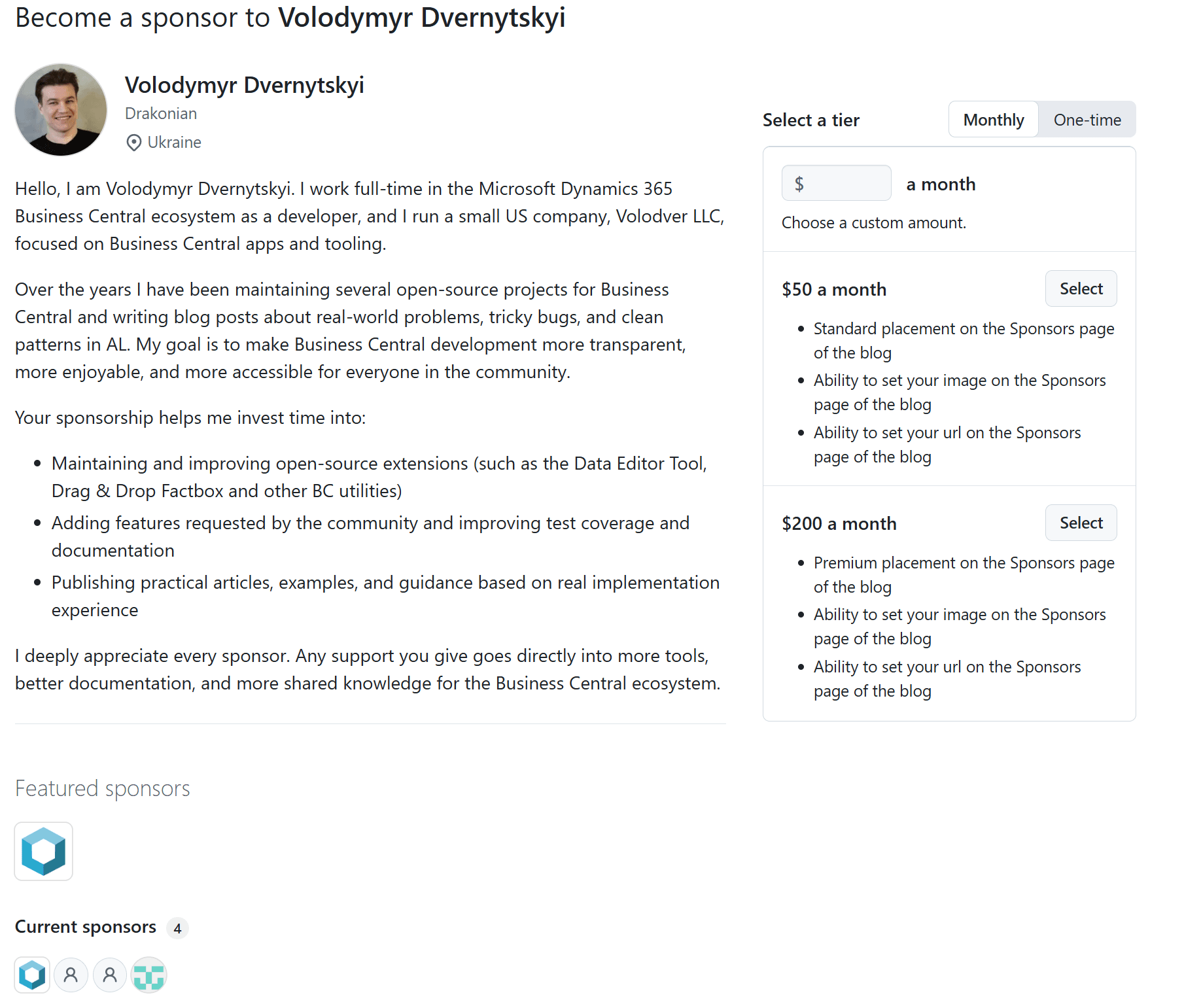
In combination with a dedicated Sponsors page on my blog. In this way, all sponsors are listed on the page, and the most generous sponsors receive the greatest visibility. I would also like to note that the design of this page was inspired by CentralQ, so I would like to thank Dmitry Katson for your excellent ideas and for not minding that I used them as inspiration.
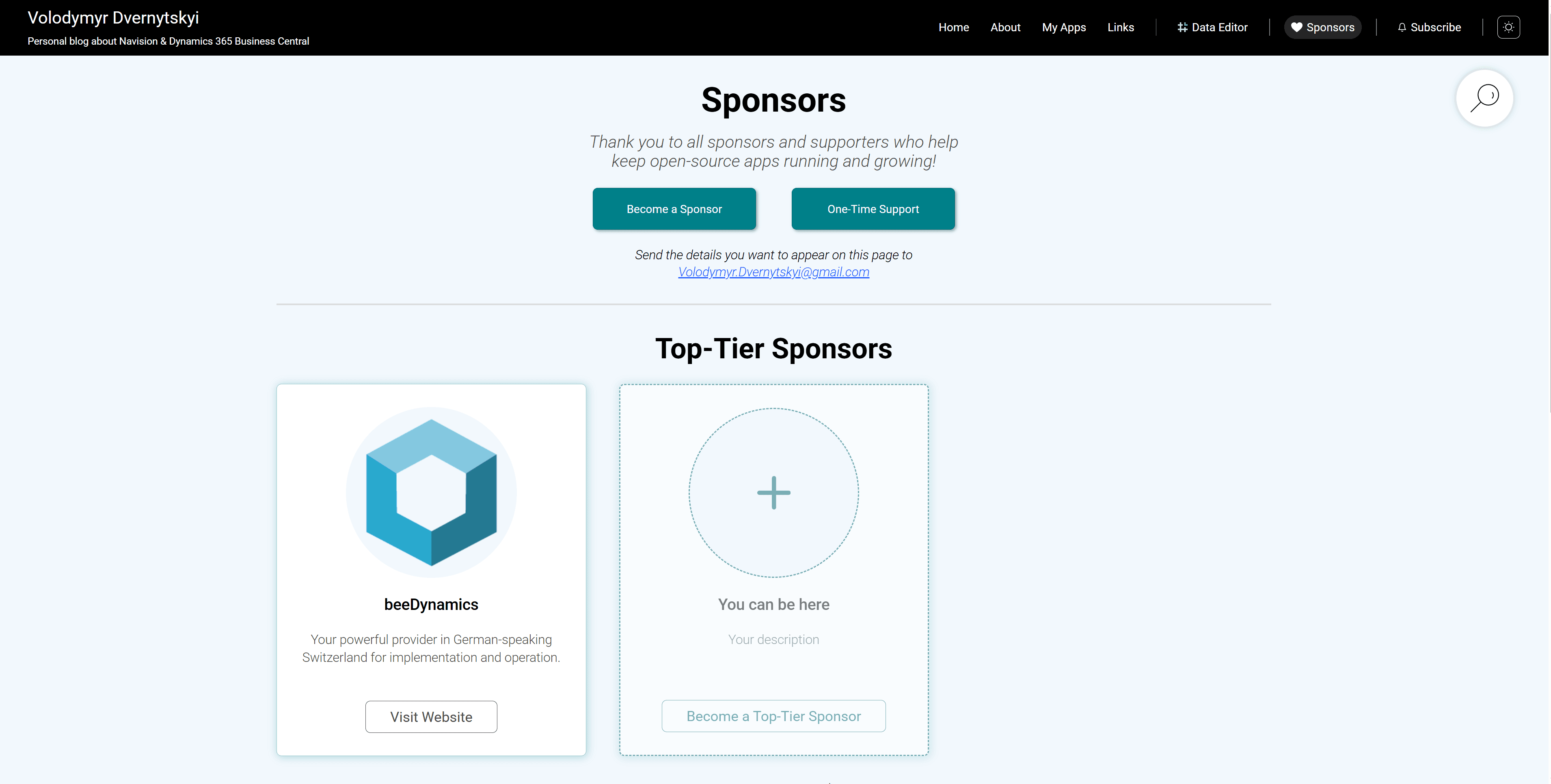
And I am very grateful to my first sponsors who chose to support my open-source work for the community. I would especially like to thank beeDynamics ag, which has always supported all of my initiatives.
For users
If you are a user, then everything I mentioned above can also be your way to provide support. At Directions for Partners, when I was speaking together with Bert Verbeek in a webinar dedicated to open source, I had several slides. One of those slides was specifically about what you, as a user, can do to support open source:
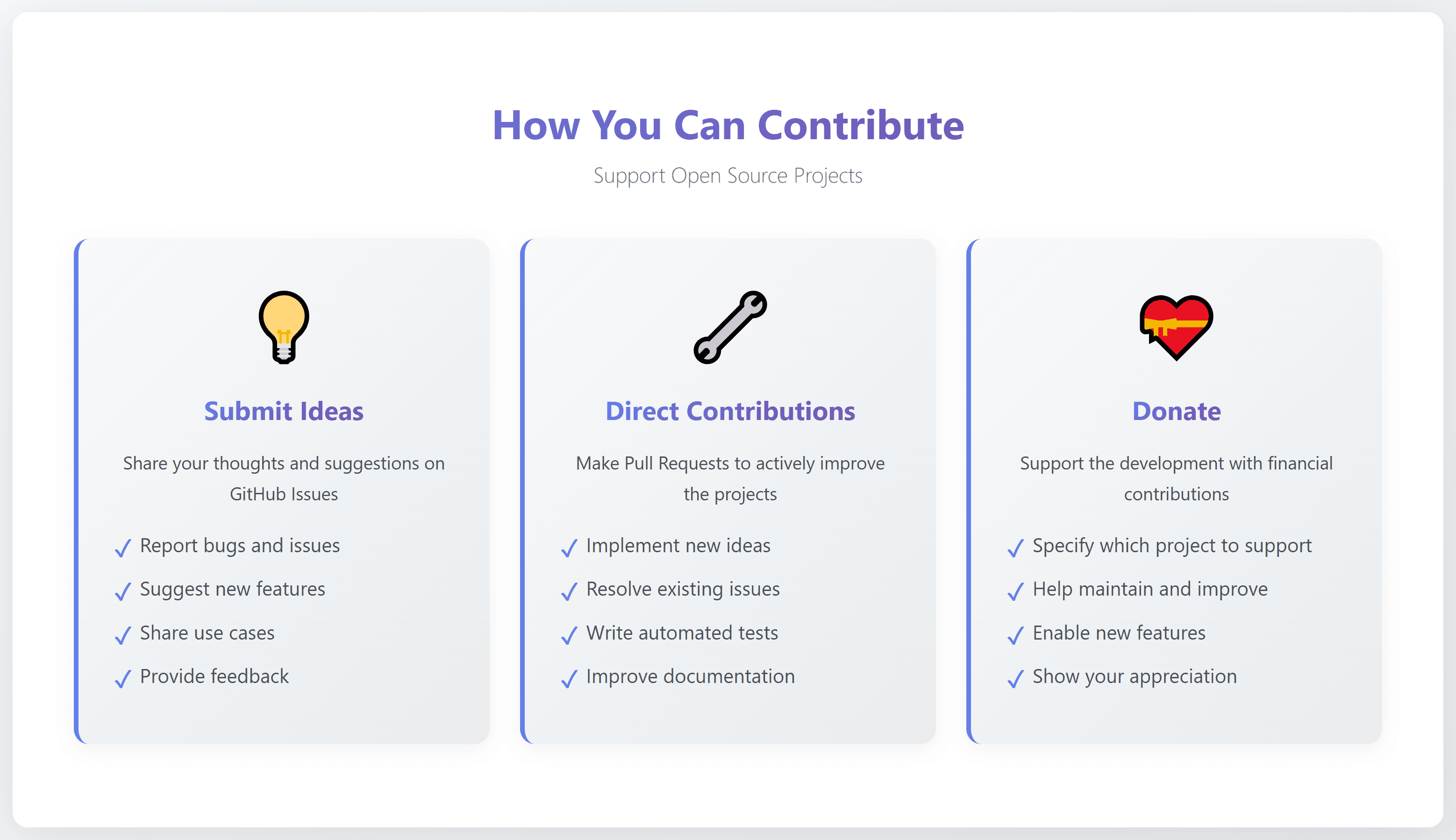
In the end, open-source is always a collaboration between maintainers and the community. Maintainers invest their evenings, weekends, and a great deal of mental energy into keeping projects alive and useful. The community, in turn, decides whether these projects will simply exist on GitHub, or will actually grow, evolve, and make a difference.
Summary
Support can take very different forms. A simple “thank you” in an issue, a star on GitHub, a short blog post or recommendation to colleagues, a pull request with a small fix, or a monthly sponsorship, all of this matters. Feedback shows that the project is needed. Contributions help it move forward faster. Donations and sponsorships give maintainers a little more stability and allow them to plan their time and priorities more confidently.
So if you use open-source in your daily work, you already benefit from someone else’s time and effort. If you want these projects to exist tomorrow as well, choose any format of support that is comfortable for you and act. Leave a review, open an issue, share a link, send a small donation, or become a sponsor. For a maintainer, this is not “a small thing” at all. This is exactly what shows that their work is truly needed.
So, if you now feel like supporting my open-source/community work, I will be very happy and grateful for any form of help:
I also would like to recommend another amazing open-source project bc2adls which maintained by Bert Verbeek.